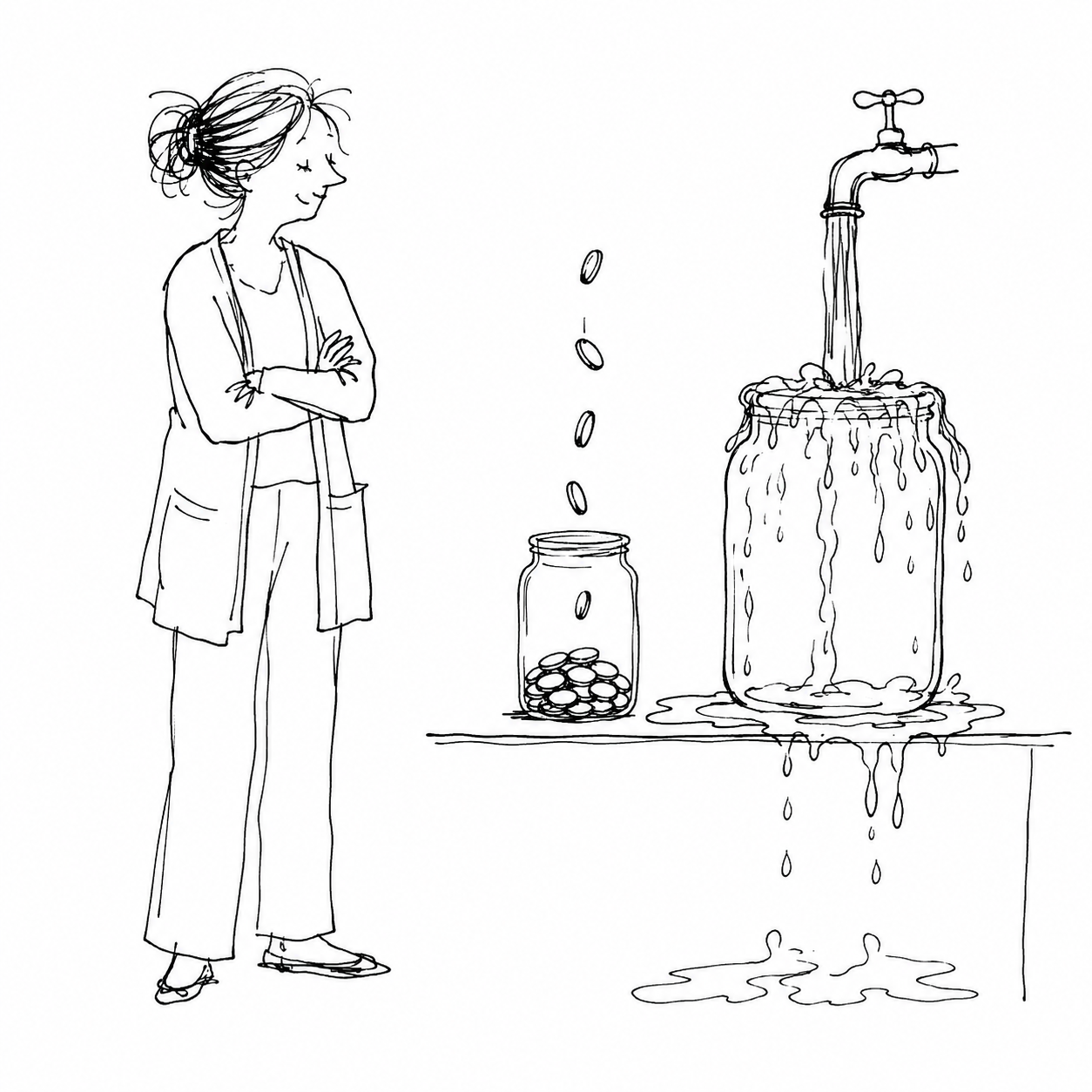
When should you use the API instead of a $20 AI subscription? Use the subscription for almost everything: writing, research, chat, anything you do by hand. Switch to the API when you run automated batches over about 20 files, deliver output to clients, or run long unattended loops. Subscriptions throttle silently under heavy automation. The API reports its own limits in plain numbers, so your code never gets blindsided.
The script ran 23 files. I came back an hour later expecting forty finished outputs sitting in a folder. The folder had a handful. No error message. No crash log. No red text anywhere. The script had just stopped somewhere in the middle, the way a kettle stops when someone quietly unplugs it, and now I was standing there counting files by hand trying to work out which ones had survived.
That is the silent failure. It is the single most disorienting thing about running automation on a chat subscription, because nothing tells you it happened. You find out the way you find out the milk went off. After.
I want to be clear before we go further, because this post gets misread as anti-subscription. It is not. I pay for the $20 plan. I would defend it in a fight. Almost everything I do all day runs on it and runs beautifully. This post is about the narrow strip of work where it stops being the right tool, and how to see that line coming before you waste an afternoon on the wrong side of it.
What "API" and "subscription" actually mean
A subscription is the chat app. Claude Pro, ChatGPT Plus, Google AI Pro (formerly Gemini Advanced), all around $20 a month. You pay a flat fee, you open a window, you type. The provider decides how much you can do this hour, and they do not always tell you the number.
The API is the back door. Same models, no chat window. Your code sends a request, gets a response, and pays per use. No monthly cap. You wire it in yourself, which is more setup, in exchange for the one thing the chat window will not give you: visibility.
That visibility is the whole story. Everything below is downstream of it.
The silent failure problem
Subscription plans are rate-limited. That part is fine and expected. The problem is the shape of the limit when you hit it mid-batch.
You do not always get a clean signal. The call times out, the loop loses its place, and the batch dies on its feet. No exception thrown. No "you have been rate limited" banner. The script reports "completed" because, technically, it finished running. It just did not finish working.
Picture a forty-image generation run on a chat plan. The app throttles image requests hard once you push past a comfortable pace, and a long unattended batch is exactly the kind of pace it does not like. So the calls start failing somewhere around file 8 or 12. The images that fail do not error. They simply do not exist. You are left doing inventory afterward, opening the folder and counting what actually landed.
"Silent failure tells: output folder has fewer files than input. Some made it, some did not. No error anywhere. Script says "done." Results say otherwise."
The jagged output problem, which is a different thing
Silent failure is when the script stops. Jagged output is when the script keeps going and quietly gets worse. Two separate failure modes. They feel nothing alike, and people lump them together, which is how you end up debugging the wrong one at midnight.
Jagged output looks like this. Your automation runs all thirty steps. The first dozen outputs are clean, on-format, exactly what you tested. Around step 13 the model starts cutting corners. Responses get shorter. Fields go missing. The format instructions you wrote in capital letters get ignored like a sign in a car park. By step 25 it is phoning it in. It never crashed. It got tired.
The mechanism is soft throttling. Push throughput on a subscription and the model does not refuse you, it just serves you with less attention under the hood. The technical version involves token budget under rate pressure. The practical version is the one that ruins your afternoon: you built a thirty-step workflow, tested it on five samples, it sang. You ran thirty for real and output 15 onward reads like a different, sleepier model wrote it.
"Jagged output tells: script completes, no errors, but later outputs are shorter, flatter, missing detail the early ones had. A quality slope running downhill through the batch."
"Silent failure is when it stops. Jagged output is when it keeps going but gets dumber. Subscriptions do both. The API does neither. (The Lazy Viber)"
The 20-file rule
Here is the threshold I actually use. It is not a law of physics, but it has held up across a lot of runs.
20 files or fewer, with forced delays between calls: subscription is fine.
More than 20 files, production work, or no patience for babysitting: use the API.
Under twenty files, you can drop a 45 to 60 second pause between calls on a chat plan and get through the batch clean. It is slow. It is mildly insulting to sit and watch. But it works. Past twenty files, those pauses stack into hours, the odds of a mid-batch timeout climb with every call, and you are now supervising a process whose entire job was to not need supervising.
If it is a workflow you will run again and again for clients, the math gets simpler still. Use the API. You cannot hand a client work that silently eats one run in three and call it a service.
Rate limiting, and why the API just tells you
On a subscription, the rate limit lives at the infrastructure level and your code cannot see it. No warning before you hit the wall. You hit it, and the call fails, or worse, degrades on the quiet. The only workaround is to pad in 45 to 60 second delays and pray the gap is wide enough, which you cannot verify, because the limits are not published cleanly and shift with your plan and the time of day.
The API plays a completely different game. Every response comes back wearing its limits on its sleeve, in headers like `x-ratelimit-remaining-requests`, `x-ratelimit-remaining-tokens`, and `x-ratelimit-reset-requests`. Your code reads those before the next call and throttles itself to the exact gap required. Not sixty seconds as a superstitious guess. The precise number. No silent death, no slow fade. Forty files in, forty clean outputs out.
"Subscription: blind 45 to 60 second delays and a prayer. API: reads its own limit headers and waits exactly as long as it has to. Not a second more."
When does the API actually get cheaper
A forty-image generation batch on the API runs a few dollars at standard quality. One-time, pay only for what you use, every call itemized in a usage dashboard you can audit line by line. Crank the resolution and quality to the top tier and that climbs, so the cheap number assumes you are not running everything at maximum.
A subscription gives you a monthly cap and zero per-request visibility. For interactive use that is a wonderful deal, because you extract a lot of value per dollar just talking to the thing. For batch automation it is the wrong shape: you pay for a ceiling you will bump your head on, with no view of how you are spending it, plus a failure mode you cannot predict.
At low volume, the subscription wins on price, full stop. At scale, running regular batches, client work, anything multi-agent, the API is almost always cheaper per output, because you only pay for what completes and you never pay for the calls that failed.
Who belongs on the API
If any of these is you, the setup is worth it.
You run batches over 20 files on a regular basis.
You deliver output to clients, where a silent failure is not an inconvenience, it is a missed deliverable.
You run multi-step loops that grind unattended for more than 20 minutes.
You run parallel agent workflows, the Lazy Parallel Terminals or Agent Team kind.
You use Claude Code, Cursor, or Codex for real development. Those tools already bill on metered, API-style usage under the hood.
Who is perfectly fine on a subscription
Everyone else. Writing, research, analysis, study guides, client reports, content repurposing, job applications. The subscription is the right call and a better experience for it: Projects, memory, the interface, all the things you give up the moment you go raw API.
The $20 plan is one of the best value purchases in software right now for interactive use. Do not complicate something that is already working.
"90% of what we sell at The Lazy Viber runs beautifully on a $20 subscription. A few automation-heavy products run better on the API. We try to be honest about which is which. (The Lazy Viber)"
How we handle this at The Lazy Viber
Products that run better on the API are labeled "API recommended" right on the product page and in the filter on the products page. Everything else is subscription-friendly, meaning a $20 Claude Pro, ChatGPT Plus, or Google AI Pro account is the whole shopping list.
We figured this out the unglamorous way. We ran every automation-heavy product at scale on plain subscription plans and wrote down where it cracked. If it hit the silent failure or the jagged output problem over and over, we labeled it API. If the subscription handled it cleanly, we left it alone and added no friction. That is the entire labeling system. No upsell logic underneath it.
The How It Works page has the short version of this for people who hit the question before they buy. This is the long version, for the people who want to know why the batch died.
If a product on the site is labeled "API recommended," this post is the why. If you want the workflow that actually survives a forty-file batch, the parallel-automation guides are built for exactly this, and they tell you upfront which plan they need. Buy once, use forever, and stop counting files by hand. Browse the automation guides: thelazyviber.com/products