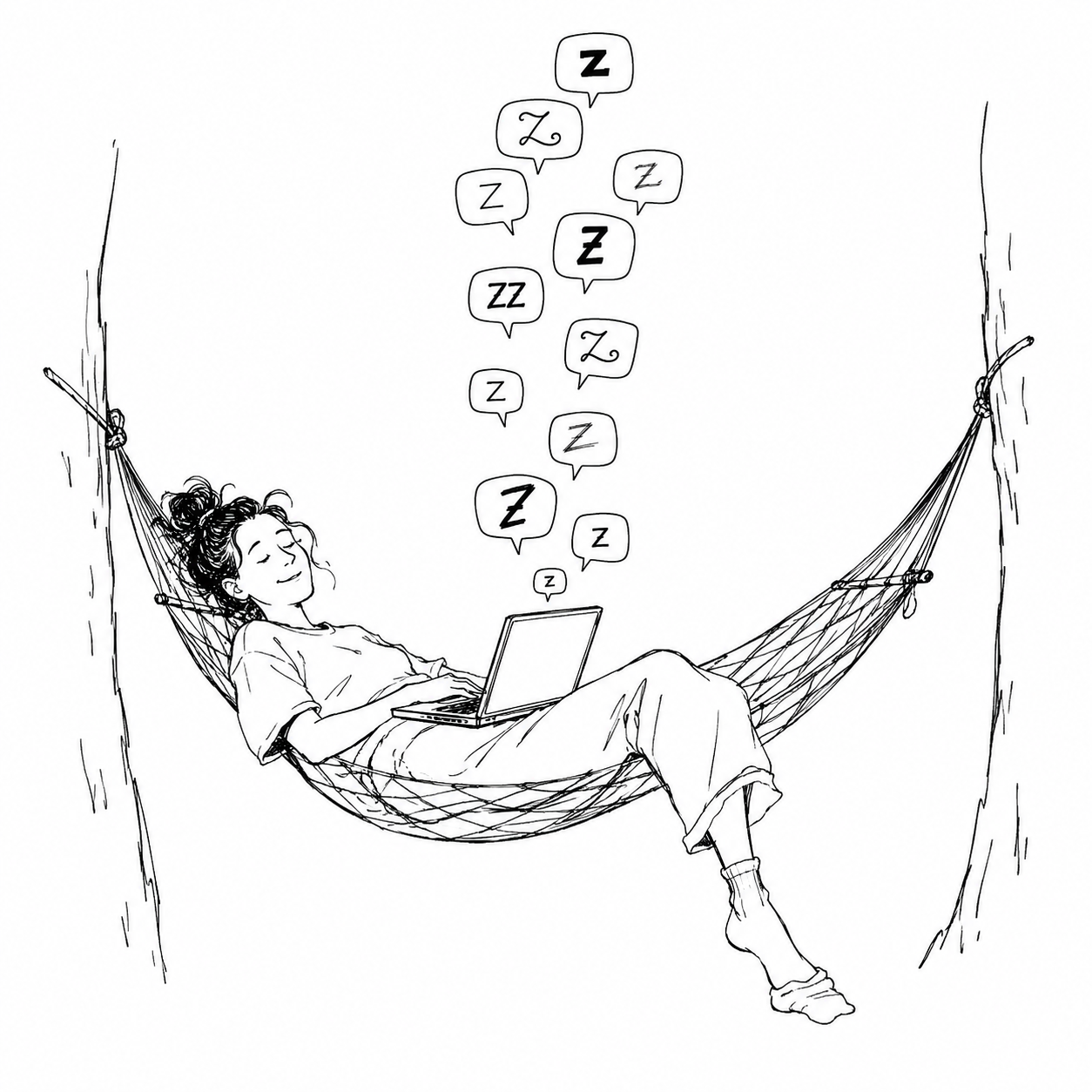
The word "lazy" fails the translation test. Open Google Translate, type it, watch what comes back in twelve languages: technically correct, culturally wrong, every time. American "lazy" carries four centuries of Calvinist anxiety. Italian carries two thousand years of treating idleness as an art. Some languages code the word as shame, some as honor, some as both. They are not the same idea wearing different spellings. They are different ideas.
The word that would not sit still
The problem started with my own brand name.
I run a thing called The Lazy Viber. In English that name is doing one specific job: reclaiming a slur. "Lazy" in American English is what your boss calls you. It is what your parents called you when you read in your room instead of mowing the lawn. It is what a productivity influencer warns you about between sips of a pre-workout that tastes like blue. The brand wraps that word in irony, hands you a nine-dollar prompt, and says: there, you just saved a thousand dollars a year by being lazy. Reclamation as a business model.
But reclamation only works if the word starts as shame. Hand "lazy" to a culture that already treats restraint as wisdom and there is nothing to reclaim. You are not flipping an insult. You are just joining a tradition that has been running since before your country had a flag.
So I started keeping a notebook. Every time I met someone from a different language background, I asked the same four questions. What is your word for "lazy"? What does it actually mean? Is it a good thing or a bad thing? And the one that paid off the most: are there kinds of laziness your language has that English does not?
Twelve languages answered. Here is what they said.
The English baseline: Calvin, capitalism, and the couch
"Lazy" in American English is a moral category, not a description. Max Weber traced the wiring in The Protestant Ethic and the Spirit of Capitalism (1905). When Calvinist theology decided that worldly success was a sign of divine favor, idleness quietly became proof of damnation. America inherited the whole framework and built an economy on top of it.
We kept the theology long after we dropped the religion. We "earn" a day off. We "deserve" rest. We call our pleasures guilty, as if joy were a tab we run up and have to settle later in productivity. We have internalized that lazy equals bad so thoroughly that we no longer notice it was ever a choice somebody made.
The brand reclaims that in English by inverting it. The lazy person is the smart one. The lazy person does not pay ninety-nine dollars a month for a tool when a two-dollar one does the same job. The lazy person does not spend six hours building a system that already exists for nine bucks. That inversion only lands because the listener already believes, somewhere underneath, that lazy is supposed to be the bad word. The reclamation works in English. It does not always export.
"The word "lazy" fails the translation test."
The tour: twelve languages, twelve versions of the word
Each language gets two parts. The literal word, and the cultural frame wrapped around it. Watch for the languages that have kinds of laziness, words English never bothered to invent. That is where the useful intelligence lives.
1. Japanese: namakemono vs hima
The shame word is 怠け者 (namakemono), literally "the one who is lazy," and it doubles as the word for a sloth, the animal. It carries Confucian-flavored shame, sharpened by postwar work culture and by karoshi, death from overwork, a category serious enough to be legally recognized as a cause of death.
But Japanese also has 暇 (hima): free time, the state of having nothing to do, and it is neutral leaning positive. "Kyou wa hima" (today I am free) is a thing you can say at dinner without apologizing. There is also yutori (ゆとり), spaciousness, room to breathe, a word that showed up in education-reform debates as pushback against overwork.
For the brand: translate toward hima and yutori. Never namakemono. The Japanese Lazy Viber sells spaciousness, not sloth.
2. Mandarin Chinese: lǎn vs tōu lǎn
懒 (lǎn) carries Confucian moral weight with no wiggle room. Confucius treated diligence as a virtue and laziness as a failing, and that shame is current, not historical. The internet has lǎn rén (懒人, lazy person), sometimes worn self-deprecatingly, but the shame underneath is not playful.
The interesting word is 偷懒 (tōu lǎn), literally "stealing laziness." It means sneaking a break, getting away with something. There is a mischief in it that sits much closer to "work smarter, not harder" than to "lazy." And then there is 躺平 (tǎng píng), "lying flat," the 2020s youth refusal of 996 work culture: politically loaded, instantly legible to anyone under thirty-five.
For the brand: reclamation is hard in Mandarin. The smarter play frames around tōu lǎn, the clever shortcut, or borrows tǎng píng energy for the younger market. Avoid lǎn.
3. Spanish: perezoso vs tomar las cosas con calma
Perezoso comes from pereza, and pereza comes from the Latin pigritia, sloth, one of the seven deadly sins. The shame here is ecclesiastical, not merely social, and Spanish-speaking cultures still feel the weight of it.
But Spanish runs a parallel track: tomar las cosas con calma (take things with calm), tranquilo (chilled), the entire vocabulary that grows up around the siesta. None of that maps to "lazy." It maps to a positive relationship with time. In Mexico, tener changarro, running a small relaxed business at your own pace, lands closer to Lazy Viber than any literal translation ever could.
For the brand: localize toward calma and tranquilo. Avoid perezoso.
4. French: paresseux vs flâneur
Paresseux is the shame word, Catholic-coded, carrying the same deadly-sin frame as Spanish.
But France has a two-century intellectual tradition of celebrating idleness on purpose. The flâneur, the cultivated urban idler, was theorized by Baudelaire in the 1860s and elevated to philosophy by Walter Benjamin in The Arcades Project (written 1927 to 1940, published in 1982, decades after he died). The flâneur does not work. He walks slowly, watches the city, produces nothing, and French letters treat him as a profound figure rather than a problem. Modern French also borrows farniente straight from Italian and uses cocooning for staying in, both warmly coded.
For the brand: France is an honor culture, not a reclaim culture. The French Lazy Viber does not argue for laziness. It joins a tradition that already exists. Cite Baudelaire. Cite Benjamin.
"Italians have a word for the sweetness of doing nothing. English has detention."
5. German: faul vs Müßiggang
Faul is the shame word, and it is the same word German uses for rotten food. Lazy and spoiled, interchangeable. German Protestantism, by way of Luther and then Weber, gives it real moral weight.
But German also has Müßiggang, cultivated idleness, the practiced art of doing nothing. The famous proverb is "Müßiggang ist aller Laster Anfang," idleness is the root of all vice. The proverb means to warn you off. The fact that the language built a high-register word for cultivated idleness tells you the culture took the concept seriously enough to be nervous about it. The nineteenth-century educated bourgeoisie treated Müßiggang as essential to cultural growth. Goethe, Schiller, and Schopenhauer all wrote in its defense. Modern Feierabend, the near-sacred status of after-work hours, descends straight from that line.
For the brand: localize toward Müßiggang and Feierabend. The German Lazy Viber is making a cultivation argument. Time spent well is time that counts.
6. Arabic: kasul vs barakah
Kasul (كسول) is the shame word, laziness as a moral failing. The Quran praises diligence and warns against sloth, and the cultural weight is real.
But Arabic culture also holds an unusually deep relationship with rest. Barakah (بركة, blessing) gets invoked around moments of presence and rest, not only around productivity. Qaylulah, the short midday rest modeled on the Prophet's own practice, is a sunnah, a recommended act. In some readings, resting at midday is a small devotion. There is also istiraha (استراحة), rest and rejuvenation as something you are owed and should take seriously.
For the brand: translate toward rest as sacred, toward istiraha and barakah. Never kasul. The Arabic Lazy Viber frames rest as a blessing, not a confession.
7. Italian: dolce far niente
The phrase is dolce far niente, the sweetness of doing nothing, and it is close to a national virtue, codified across centuries of Italian art and letters. Cicero wrote about otium, the productive leisure that grew philosophy. The Renaissance courts cultivated it. Modern Italy treats long lunches, the evening passeggiata, and the August shutdown as non-negotiable.
The shame word, pigro, exists, but it feels archaic and rarely bites. Italians do not generally accept "lazy" as an insult. They accept it as a reasonable description of a good life. The 2010 film Eat Pray Love carried dolce far niente into English-speaking ears, though the concept runs back to Pliny the Younger's first-century letters. Italy did not need a Hollywood movie to know what it meant. The Eat Pray Love book actually leans on the sibling phrase "il bel far niente," the beauty of doing nothing, while the film's famous line uses "dolce far niente."
For the brand: Italy is the most natural honor culture for Lazy Viber. Do not argue for anything. Use the dolce far niente register and trust the reader.
8. Brazilian Portuguese: malandragem
The literal lazy word is preguiçoso, Catholic-coded, cousin to Spanish. Skip it.
The word worth knowing is malandragem, the philosophy of the clever shortcut: working with the system instead of against it, finding the jeitinho, the little way, around a problem. Anthropologist Roberto DaMatta wrote about it in Carnivals, Rogues, and Heroes (1979) as a distinctly Brazilian archetype. The malandro, the streetwise trickster of samba lyrics, is romanticized in popular culture. Bossa nova and samba both run on a relaxed-but-sharp sensibility that matches Lazy Viber almost exactly.
For the brand: translate toward malandragem and jeitinho. Never preguiçoso. The Brazilian Lazy Viber is the clever shortcut artist, not the slacker.
9. Russian: lyen and Oblomov
Лень (lyen) is the laziness word, and its cultural meaning was shaped almost entirely by one book: Ivan Goncharov's Oblomov (1859). The protagonist spends most of the novel in his dressing gown, unable to get out of bed, and Russia has read him for a century and a half as a meditation on the national soul rather than a character study. Critic Nikolai Dobrolyubov's 1859 essay "What Is Oblomovism?" framed lyen as a national trait worth taking seriously, and the argument has not stopped since.
Modern Russian uses lyen with affection as often as with judgment. "Mne len" (I am too lazy) is everyday casual speech, carrying almost no shame.
For the brand: Russian gives you room. Reference Oblomov directly and the educated reader gets it. Lean philosophical.
10. Korean: ge-eu-reum vs no-jam
게으름 (ge-eu-reum) is the shame word in standard Korean, sharpened by one of the most overworked cultures in the OECD: the study grind, the long hours, the relentless expectation of output.
But Korean youth culture built a counter-vocabulary. No-jam (노잼, "no fun") names the rejection of grind culture. Honjok (혼족, the tribe of one) describes people who eat, drink, and travel alone, refusing the social productivity script. And sohwakhaeng (소확행), "small but certain happiness," became a movement, even if the phrase itself was lifted from a Haruki Murakami essay before Korea made it its own.
For the brand: reclamation is possible in Korean by aligning with sohwakhaeng and honjok. The Korean Lazy Viber argues for small, certain, unproductive joys.
11. Hindi: aalas vs aaram
आलस (aalas) is the shame word, the one parents and teachers and bosses reach for. India's Brahmanical work-ethic tradition and modern professional culture both line up against it.
But Hindi also has आराम (aaram), rest, ease, comfort, and it is everywhere and warmly coded. "Aaram se" (with ease, take it easy) is daily speech. The phrase "aaram haram hai" (rest is forbidden) was Jawaharlal Nehru's own slogan, and decades of quiet cultural pushback against it have left a generation comfortable telling each other "aaram karo," take rest, with no shame attached.
For the brand: translate toward aaram. Avoid aalas. The Hindi Lazy Viber is the brand of comfortable ease, not idle slackness.
12. Dutch: lui and the half-Friday
Lui is the lazy word, technically negative. But Dutch culture treats work-life balance as a moral good. The Netherlands has the highest rate of part-time work in the OECD, around a third of all workers and more than half of women, by choice. Friday afternoon is widely optional. The borrel, the informal end-of-day drink, is sacred.
The Dutch concept of gezelligheid, coziness and unhurried togetherness, works as a national positive value. Niksen, the deliberate practice of doing nothing, became a 2019 wellness trend abroad, and it is a real Dutch word for a real Dutch thing. Domestically, niksen is less celebrated than its export branding suggests, since doing nothing can still read as lazy at home, so the local frame is leaning honor, not settled honor.
For the brand: Dutch leans honor. Localize toward gezelligheid and niksen, and let the part-time culture do the rest of the arguing for you.
Two playbooks: reclaim or join
Sort the twelve by what the brand actually has to do, and the picture clears up fast.
Reclaim cultures: English, Mandarin, Korean, Hindi, and partly Arabic. Here the literal word is shame-coded and the dominant work culture punishes restraint. The brand has to do real work: argue for the counter-virtue, frame restraint as intelligence, earn the right to use the word with irony. The playbook is the one I already run in English. Lead with the math (you saved $1,185 a year by being lazy). Lead with the outcome (the lazy person shipped first). Invert the logic until the busy person is the one who looks like they are failing.
Honor cultures: Italian, French, German, Dutch, Brazilian Portuguese. Here the tradition of restraint-as-virtue is deep and codified. Dolce far niente, flâneur, Müßiggang, gezelligheid, malandragem. The brand does not argue. It joins. Use the local positive word instead of translating "lazy," cite the local tradition (Baudelaire in France, Goethe in Germany, DaMatta in Brazil), and trust the reader to already be on your side. Same nine-dollar prompt. Two thousand years of cover.
Hybrid: Russian, Japanese, Spanish. These carry both a shame word and a contemplative-leisure tradition in active use, so the brand picks its register by audience. Hima for the Japanese reader tired of karoshi. Oblomov for the philosophical Russian. Tranquilo for the Spanish speaker who already knows what siesta means. Two registers, one product, separate copy decks per market.
"Reclaim or join. There are two ways to be Lazy Viber abroad, and the brand has to know which one it is doing in each country."
"Lazy" as a Rorschach test
After mapping the twelve, I noticed something that was not on my list when I started.
"Lazy" is not a universal vice. It is a cultural Rorschach test. What a society calls lazy tells you what that society is anxious about. American "lazy" tells you America is anxious about productivity as a measure of human worth. Mandarin lǎn tells you Confucian moral order still organizes the culture. Italy's near-absence of a word that bites tells you Italy decided, a long time ago, that sweetness was a legitimate goal.
Twelve languages produced twelve versions of one word. Some shame, some honor, some both, some neither. Which tells you the concept was never really about the behavior. It was always about the culture doing the naming.
That is not a bug in the brand. It is the whole insight. The same brand that sells reclamation in English sells malandragem in Brazil, flânerie in France, and hima in Japan. The product never changes: a one-time nine-dollar prompt that replaces a ninety-nine-dollar-a-month tool. The cultural frame changes into twelve different things. It is the same reason our Dollar Bin works in English, where a 1978 dollar-bin record store is a specific cultural memory. That memory does not exist in Portuguese, so the Brazilian version gets a different name and a different reference. Brand mechanics are downstream of cultural frames. Always.
The soft close
Doing less, smarter, is global. We just have not agreed on what to call it.
If you are reading this in English, "lazy" is the reclamation. If you are reading it in French, you are already inside a tradition you know, and Baudelaire would have bought the nine-dollar prompt and used it to write longer essays on shorter afternoons. If you are reading it in Brazilian Portuguese, the brand is malandro: clever, relaxed, finding the jeitinho.
Take the brand. Take the products. Take the dolce far niente. The version of "lazy" your culture handed you is one of twelve. None of them are wrong. Only one of them ever needed reclaiming.
We translate the word. We do not translate the position.
Browse the catalog at thelazyviber.com/products. More like this in your inbox at thelazyviber.com/newsletter.